


Idle Lumber Empire: Tycoon Inc
AppQuantum
I spent time with Idle Lumber Empire: Tycoon Inc. as a casual simulation game, and my first impression was clear: it is built for people who enjoy watching a small operation become more efficient one upgrade at a time. You begin with the basic idea of running a logging business, then gradually turn that simple loop into a larger idle production setup. The appeal is not deep forestry management or a demanding strategy campaign. It is the steady rhythm of collecting earnings, improving the operation, and returning later to see what has changed.
That makes it an easy game to understand, but not automatically an easy game to enjoy for everyone. I found the best experience came from treating it as a short-session progress game rather than a full-time management simulator. A few minutes can be enough to make useful decisions, while longer sessions are available when I wanted to push upgrades forward. If you like incremental games with a business theme, this is a friendly entry point. If you want detailed logistics, realistic economics, or constant hands-on control, its simplified design may feel limiting.
What to consider before choosing this lumber tycoon
The central decision is whether you enjoy idle progression more than direct action. The game is about improving a logging factory and building an increasingly productive lumber business, but much of the satisfaction comes from arranging upgrades and letting the system generate progress. I was rarely asking, “Can I execute this difficult move?” Instead, I was asking, “Which improvement will make my next return more valuable?”
Related News

EA SPORTS FC Mobile Is Excellent Football, but Not for Every Player

Google Lens: Your Pocket Guide to the World

How to Turn Zillow Into a Smarter Home-Search System
That distinction matters when comparing it with other simulation games. A construction simulator may focus on operating vehicles or completing physical tasks. A city builder may ask you to balance roads, housing, services, and space. A traditional tycoon game may give you more detailed control over prices, staff, supply chains, and competition. This game sits in a lighter category: it uses the language of a lumber business while keeping the interaction approachable and repetitive.
I also considered how much patience the game expects. Idle games are designed around gradual accumulation, so the early excitement can soften once the basic pattern becomes familiar. The strongest reason to continue is usually the next improvement, not a constantly changing set of activities. That is enjoyable when I want a low-pressure routine, but less satisfying when I am looking for surprises every few minutes.
Related News

Why WhatsApp Messenger Still Makes Everyday Communication Feel Easy

Jurassic World: The Game Is the Better Dino Tycoon for Strategic Players

Threads in Real Life: Who Should Join, Lurk, or Leave

How SHEIN Turned Shopping Into an Endless Content Feed

How to Make Fortnite Feel Smarter on Mobile

Should You Switch to Microsoft Outlook on Mobile?
On the practical side, the game is free to download and is suitable for Everyone. It comes from AppQuantum and is listed for Android with a minimum operating system requirement of 10. The current version is 1.12.2, so anyone checking compatibility should compare that requirement with the software on their device before installing.
The first sessions: simple controls, clear goals
The opening experience is easy to follow because the theme does most of the explaining. Logs come in, the factory processes them, and the resulting business activity creates money for further development. I did not need a long tutorial to understand the basic purpose. The visual presentation and upgrade prompts make the next step obvious, which is useful for players who do not normally play management games.
That simplicity is one of the game’s strongest choices. I could open it while waiting for an appointment, collect what had accumulated, make one or two improvements, and close it without losing the thread. The game does not demand that I remember a complicated control scheme. The important question is usually visible on the screen: improve the part of the operation that will help the next stage of progress.
Gallery
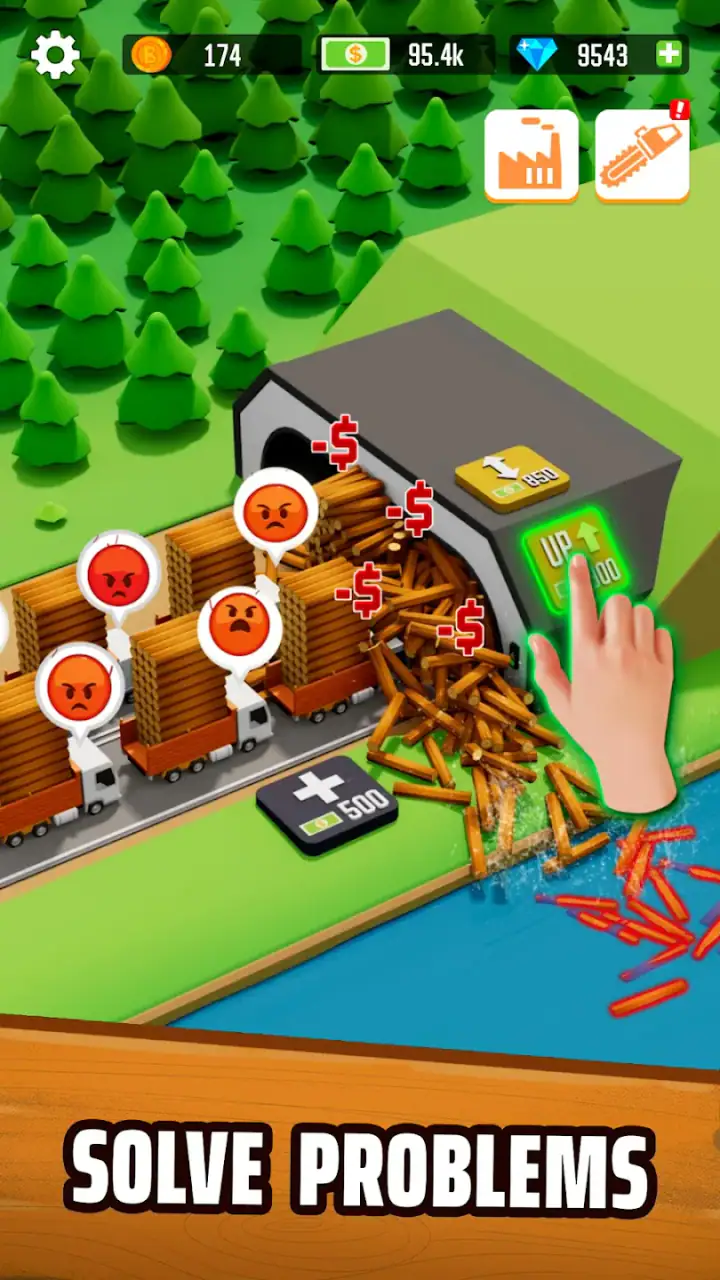
At the same time, the straightforward structure means the game does not offer the same mental challenge as a detailed economic simulator. There is a difference between choosing the best upgrade in a compact idle system and managing a business with many competing variables. I enjoyed the former, but readers expecting the latter should adjust their expectations before downloading.
How I approached upgrades instead of tapping blindly
One useful habit is to avoid spending every available resource immediately. It is tempting to purchase the first affordable improvement because the interface constantly presents another opportunity. I found it better to pause and look at the whole production flow. An upgrade that improves the part of the operation creating a bottleneck can be more useful than a cheaper improvement that looks attractive on its own.
This is a small but important trade-off. Idle games often reward short-term visual progress, while the better decision may be to save for an improvement that changes the pace of the entire operation. I began checking whether my next purchase would increase income, reduce a delay, or simply make one screen look more advanced. That habit made the business feel more deliberate and reduced the sense of randomly pressing buttons.
Another practical approach is to separate active play from return visits. During an active session, I focused on upgrades and any available tasks that required attention. Before closing the game, I made sure the operation was not sitting on an obvious unclaimed reward or an affordable improvement. When I returned later, I could collect the idle progress and decide whether to reinvest immediately or wait for a larger purchase.
The most useful mindset is to treat each return visit as a small planning session, not a race to spend everything. That makes the loop feel less repetitive and helps the available resources work toward a clear goal.
Where the game is especially comfortable
The strongest use case is casual play during small gaps in the day. I can imagine opening it during a commute break, after finishing a household task, or in the evening when I want something interactive but not stressful. The lumber theme gives the progress a recognizable shape, and the factory setting makes each improvement feel connected to the larger business rather than being a completely abstract number generator.
It is also a good fit for players who like seeing a modest operation grow over time. The satisfaction comes from comparing the current state with the earlier one: the business feels busier, the next target becomes more ambitious, and the idle returns give a reason to check back. That sense of gradual ownership is more important here than reflexes or narrative.
The game’s Everyone rating makes it approachable for a broad audience, although an age rating is not the same thing as a promise that every player will enjoy the monetization or repetition of the idle genre. I would recommend explaining the basic loop to younger players and setting spending boundaries on a shared device, especially because optional in-app purchases range from $0.99 to $99.99 per item.
Where the design starts to show its limits
The same idle structure that makes the game relaxing can also become predictable. Once I understood the pattern of collecting, upgrading, and waiting, the novelty depended heavily on how motivated I felt by the next milestone. If I was already in the mood for incremental progress, that was enough. If I wanted a fresh challenge, the repeated cycle felt less compelling.
The game may also frustrate players who want every decision to have a visible, immediate consequence. Idle systems are intentionally slower. Some improvements matter because they increase future earnings rather than producing an instant dramatic change. That delayed payoff is part of the design, but it can make progress feel modest during a short session.
Purchases are another point to consider carefully. The game is free, which makes it easy to try, but the presence of paid items means the experience is not purely about waiting and planning. I recommend playing without spending at first. That gives you a fair idea of whether the underlying loop is enjoyable. If the only satisfying moments arrive after considering a purchase, the game is probably not the right fit for your preferences.
I would also skip it if your ideal simulation involves designing a complex factory layout, negotiating with competitors, balancing multiple resources, or directly controlling machinery. The lumber setting may suggest a more detailed industrial game than this actually is. Here, the business theme supports a streamlined clicker-style progression system rather than a realistic operational model.
How it compares with other choices and what switching really means
When a lighter alternative is the better choice
Compared with action-oriented management games, this one wins on convenience. I do not need to commit to a long session or master complicated controls before I can make progress. That makes it a better choice for someone who wants a game that can be checked repeatedly throughout the day. A more active alternative will usually be stronger for players who want constant input, immediate feedback, and a sense that their physical skill affects the result.
Compared with city-building games, the focus is narrower. That narrowness is helpful because I am not juggling an entire population or planning a large urban space. The trade-off is that I get fewer layers of responsibility. If you enjoy solving problems caused by traffic, services, land use, or competing districts, a city builder will likely offer more variety. If those systems sound like work and you would rather improve one recognizable business loop, this game is easier to settle into.
Compared with traditional tycoon games, the game is more welcoming but less demanding. I can understand the basic objective quickly, and the interface does not ask me to become an accountant. The cost is that the business decisions are more guided. Players who want to set detailed prices, negotiate contracts, or respond to a changing market may find the experience too controlled.
Compared with other idle games, the logging-factory theme gives the progression a concrete identity. That does not remove the genre’s familiar repetition, but it helps the upgrades feel like parts of one growing enterprise. For me, that was enough to make the early and middle stages more engaging than a completely generic number-increase loop.
What you give up when moving away from it
Switching to a more complex simulator can provide richer decisions, but it also raises the time cost. You may need longer sessions, more reading, and more attention to systems that can fail if ignored. That is worthwhile for players who want depth, but it defeats the purpose if you mainly want a relaxing progress check.
Moving to a more action-heavy game changes the feeling of control. You will probably do more yourself and wait less, but you may lose the pleasant surprise of returning to a business that has continued working while you were away. The idle element is not a minor decoration; it is the reason this game works as a background hobby.
Leaving for another idle game may preserve the convenient session length, but the theme becomes the deciding factor. If you do not care about logging or factory growth, a different setting may hold your attention longer. If the lumber-business presentation appeals to you, switching too quickly may mean giving up a theme that makes the familiar idle formula easier to follow.
How to decide whether spending is worthwhile
I would approach the purchase system as an optional convenience rather than a requirement. Play long enough to learn whether you enjoy the normal rhythm. Notice how often you feel interested in making a decision versus simply waiting for the next collection. If you like planning upgrades without paying, that is a good sign. If you feel pressured to buy whenever progress slows, stop and reconsider.
A sensible personal rule is to avoid buying during a moment of impatience. Idle games are specifically built around delayed progress, so a purchase can feel unusually tempting when a target is just out of reach. Waiting, closing the game, and returning later is a useful test of whether the game remains enjoyable without spending. Because individual items can reach $99.99, device-level purchase controls are worth using if children or other family members can access the account.
The free entry point does make experimentation easy. You can install it, play through the early loop, and decide based on your own tolerance for waiting. I see that as a real advantage over games that require a commitment before you know whether their management style suits you.
Who should download it
I recommend it to players who enjoy idle business games, visible upgrade paths, and short visits that add up over time. It is particularly suitable if you like the idea of turning a small logging operation into a more capable factory without having to manage every detail manually. It is also a reasonable choice for someone new to simulation games because the core objective is easy to grasp.
I would be more cautious for players who need a strong story, constant novelty, competitive pressure, or realistic industrial detail. The game’s appeal depends on enjoying the process of gradual improvement. If you usually abandon a game once the basic routine becomes familiar, the long-term loop may not hold you.
The audience size suggests that the concept has broad appeal: the game has passed 100 million installs, with an average rating of 4.0 from around 1.1 million ratings and roughly 13 thousand written reviews. I would read those figures as evidence that the format is accessible, not as proof that it will match every player’s taste. Idle games can be especially divisive because the same waiting mechanic feels relaxing to one person and boring to another.
My recommendation after playing
My recommendation is to try it if you want a free, low-pressure simulation that turns a logging theme into a simple upgrade routine. I liked the way it fits around ordinary life: I could make progress in a short session, leave it alone, and return when I wanted another small planning decision. The best results came from watching for bottlenecks, saving for meaningful improvements, and resisting the urge to spend resources just because an upgrade was available.
I would not present it as a replacement for a deep tycoon simulator. It is better understood as an approachable idle game with a factory-and-lumber identity. That distinction sets the right expectations and makes its strengths easier to appreciate. The current version, 1.12.2, is available for devices running Android 10 or later, and the game can be tried without an upfront price.
In the end, Idle Lumber Empire: Tycoon Inc. works best when you want progress that continues in the background and decisions that remain easy to pick up. It is not the right choice for demanding management or constant action, but it is a pleasant option for relaxed, repeat visits. I would download it, play without purchasing anything at first, and keep it only if the simple satisfaction of improving one lumber business continues to feel rewarding after the opening sessions.
FAQs for Idle Lumber Empire: Tycoon Inc
What is Idle Lumber Empire: Tycoon Inc. about?
Idle Lumber Empire: Tycoon Inc. is a simulation game where players manage and grow a lumber business. Players start with a small sawmill and gradually expand their empire by hiring workers, upgrading equipment, and managing resources efficiently. The game features idle mechanics, allowing progress even when not actively playing, making it a perfect blend of strategy and casual gaming.
Is Idle Lumber Empire: Tycoon Inc. free to play?
Yes, Idle Lumber Empire: Tycoon Inc. is free to download and play. However, it offers in-app purchases that allow players to buy resources, upgrades, or remove ads. While these purchases can enhance gameplay, they are entirely optional, and players can enjoy the game without spending money.
What platforms is Idle Lumber Empire: Tycoon Inc. available on?
Idle Lumber Empire: Tycoon Inc. is available on both Android and iOS platforms. Players can download it from the Google Play Store or the Apple App Store, ensuring accessibility to a wide range of mobile users. Regular updates are provided to enhance the gaming experience and introduce new features.
Can I play Idle Lumber Empire: Tycoon Inc. offline?
Idle Lumber Empire: Tycoon Inc. requires an internet connection for initial downloads and periodic updates. However, the game can be played offline once installed, making it a convenient option for players who want to enjoy the game without constant internet access. Offline play may limit certain features, like leaderboards or social interactions.
What makes Idle Lumber Empire: Tycoon Inc. different from other idle games?
Idle Lumber Empire: Tycoon Inc. stands out with its unique lumber industry theme and detailed management mechanics. Players not only focus on earning profits but also on optimizing production lines, hiring skilled workers, and balancing resource allocations. Its engaging graphics and immersive gameplay provide a refreshing twist to the idle game genre.
Pros
- Engaging and easy-to-learn gameplay.
- Visually appealing graphics and design.
- Regular updates with new content.
- Offline play available for convenience.
- Rewarding progression system.
Cons
- Can become repetitive over time.
- In-app purchases can be costly.
- Ads may disrupt gameplay experience.
- Requires a stable internet for updates.
- Limited strategic depth for advanced players.


